Episode Transcript
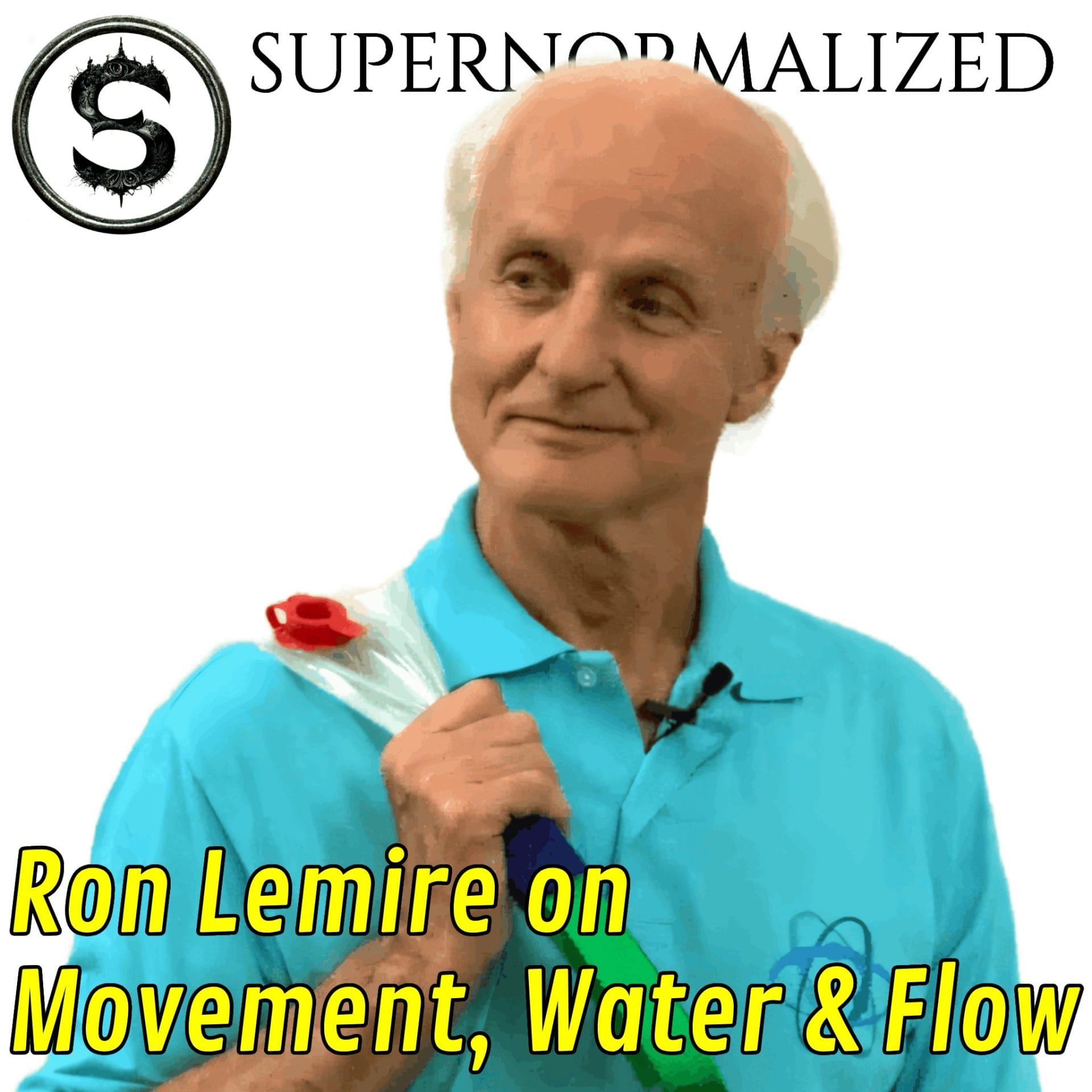
[00:00:00] Speaker A: Today on Super Normalized, Ron Lemera joins us and he's a movement teacher, healer, inventor, and five decades of hands on work. Ron brings stories from 10 years on the road with John Denver and a season within Indiana Pacers, a year as a whirling dervish in a lifetime refining water based proprioceptive training, expect practical micro practices, physics forward spiritual insights and vivid road tales. Ron's a character and I'm going to say he's the quintessential renaissance man in that he seems to have been at all the right places at the right time to experience what we see now in the west as the, you could call it like the forefront of the field itself, inviting all of us towards spirituality. This is a really good episode. I really enjoyed talking with Ron and I'm sure you will too. Welcome to Super Normalized. Ron Lemaire. Did I say your surname right, sir?
[00:00:58] Speaker B: Yes.
[00:00:58] Speaker A: Excellent.
[00:00:59] Speaker B: All right.
[00:00:59] Speaker A: I'm glad I got that right. So, Ron, you're a structural movement teacher, healer, inventor and storyteller with over 50 years of hands on work across music tours, pro sports clinics and apprenticeships that cross western and traditional medicines. You build a practice where water becomes the teacher and movement becomes meditation and the nervous system becomes the map for presence and performance. I'd really like to hear all the stories around that. So really I want to welcome you to the show.
[00:01:26] Speaker B: Thanks.
[00:01:27] Speaker A: Yeah. So let's have a look at the body as a portal to presence. What does the nervous system ask for when we trade force for just plain sensing?
[00:01:38] Speaker B: Can you repeat that question?
[00:01:40] Speaker A: What does a nervous system ask for when we trade force for sensing?
[00:01:46] Speaker B: Kind of depends the situation.
[00:01:48] Speaker A: Yeah.
[00:01:48] Speaker B: The nervous system is the mind. It's everything. A thought is an electrical impulse. So how does that affect your, your, your nervous system as far as like working out and stuff? We, we've had a tendency to kind of overdo it by just concentrating on the main muscles and yet meanwhile, which is kind of a linear format.
Meanwhile, it's kind of ironic that most of sports movements, or most of dance movements, martial arts, are circular. And so the circular motion is what really helps our spiral body. Our spiral body is both hemispheres, like almost like a helix kind of going back and forth, which is basically governed by the nervous system, the central nervous system. When you think about the nervous system in the body, you have to think of the vestibular system, which is balanced and it communicates with the cerebellum. And that has to do with how you interpret the ground. How does gravity come through you when and if it comes, when it comes through you, you. You respond to it. That's kind of our nervous system.
It's quick and, and there's ways to feed it. There's ways to over amp it. So in today's world, most people are in what you call a sympathetic overload, which means that they produce more cortisol than they really need to. The reality that they're in, meanwhile, the reality that they're in is producing the cortisol to meet that reality.
[00:03:21] Speaker A: Yeah, right.
[00:03:22] Speaker B: We can change that by, you know, quieting our minds and by quiet.
[00:03:29] Speaker A: Is that like a bit of a negative feedback loop that happens for us because of exposure to all of the media and things like that?
[00:03:36] Speaker B: Yeah.
In today's world, there's an information overload which taxes the nervous system in such a way that if you're responding with all that information, then you have to excrete all of this cortisol. Yet you are what you call a sympathetic overload. When you're in a sympathetic overload, the parasympathetic nervous system, which is basically, you know, the unconscious one, like sleeping, eating, digesting, all of that stuff that, that kind of needs to be quiet is disturbed. And as a result, people are not sleeping well at night. And it, it takes a toll on the health.
[00:04:14] Speaker A: Yeah.
[00:04:15] Speaker B: I think, you know, when you ask, is it your original question, is it speeding? Are we speeding up or slowing down? Or slowing down.
Is that a good way to train?
[00:04:25] Speaker A: Yeah, but it sounds like instead of pushing, it's more like allowing for change.
[00:04:30] Speaker B: Yeah.
You know, it's two things. You want to be able to push it. If you're an athlete, you're not going to. You're not going to do Tai Chi. You know, you're. You're going to want to, you know, you're at that age where you got a lot of energy and you're in competition and stuff, and it's a different kind of pushing. And that kind of pushing you have, if you have a good coach, the coach will let you know if it's too much or too little. But what's really complimentary, and this can happen at any, any age, literally, is to understand how to slow down your world. Because if you think about it, if you ever go into. If you ever hack into the zone, as they call it, that very angelic place where options are plentiful and time is timeless, there's ways to get there, and you get there more through the quiet realm than you do through the noisy realm.
[00:05:17] Speaker A: Why does coordination build flow? More reliably than intensity in the sense
[00:05:23] Speaker B: of what I represent. As far as the fluid dynamic system. When we were children crawling, we had, we were, we were connecting our nervous system through opposite, opposite hand, opposite leg. As we were crawling, that started to coordinate our proprioceptive awareness. That started coordinating our sense of balance to both sides.
Then when we got up, we lost contact with that we had no longer had tangible connection with the floor. You know, the floor gave us all of this information. And the floor, when we were pushing against it and crawling was when we first came upon ground reaction. And that ground reaction densified our bones. The opposite movement with gravity. Gravity is what densified our bones. So then when we got up in an upright position, we never really learned how to stand because we were, we were. So much was going on within that we had to thrust forward. And when we did, we reestablished our cross crawl pattern. Opposite arm, opposite right. Sometimes that pattern is, has been disturbed. If parents put them in a, in a walkies there to put the kid in and the kid just rolls around, doesn't crawl, passes the crawling stage. So the crawling stage is real important. And what I found over the years and having treated a number of people is that that that particular sense of coordination of left and right hemisphere has been disturbed. So why coordination is important is because if you learn, if you wear your heels, plant how they pivot the tips of your toes, plan, if you're in a transverse plane, if you lot, if you can actually have good habits around that you won't get hurt. Like for example, a tennis player going after a ball, for example, and swings and the body twists, but the leg stays planted. And it stays planted, it may torque the fibula, which then throws the knee out of place. So these particular placements of how athletes work, if, if they are really coordinated, if they, if they are practiced and it becomes like second nature, then most likely injuries won't happen. Injuries happen because the base is not secure.
[00:07:43] Speaker A: Would that also mean that the body then in that state is more disengaged rather than awake?
[00:07:49] Speaker B: Well, it assumes that it's awake.
[00:07:52] Speaker A: Yeah, that's what I mean.
[00:07:53] Speaker B: Yeah, it's disengaged. I mean, for example, when I work on people I know, like I see some people that look at them and they're tilting like, you know, 12 degrees and they think they're straight.
[00:08:05] Speaker A: Yes.
[00:08:06] Speaker B: You know, because they, they have their, their new alignment is that's how they function and that's what's straight for them. But the alignment is when both hemispheres work together evenly. One of the things we talked about earlier was 92% of the world's population is right hand. Is right hand dominant?
That's a lot. That's 92% of the population. So that kind of coordinates with how the earth turns. The earth turns in a counterclockwise way. And if we're throwing right handed, for example, and we circularize that movement, it's counterclockwise. So our axis is also tilting the same way the earth's flows. So we don't really have a true alignment. But in the early 60s, you know, when, when our generation experienced this revolution, sex, drugs, rock and roll, et cetera, something also happened that kind of went by unnoticed. We became the midwives to the east. We brought in martial arts, meditation, Ayurvedic medicine, Japanese martial arts, diet, five elements. All of that stuff started coming.
And when we started adapting to that, we no longer were dominant one side. So but before they came, for example, like a fighting mode, for example, I mean I was a boxer and so I was a lefty, right, I jabbed my left and that was mostly one sided. And my right dominant was going to be, you know, if I, if I wanted to finish it. But I never finished it with the right hand, I always did it with the left hook. But what I'm trying to get at is I trained my dominant side and that's what we did.
And then when these martial arts came in, it wasn't about fighting one sided, it was about learning the katas on both sides. When Jung came in, it was about both sides. You did it to both sides. So from the 60s to now, we have been really migrating towards a stronger alignment because both hemispheres now are starting to work a little better together. And so that, that dominant side, if we stay dominant, if we remain in the dominant side, the longevity is not going to be there. If we start training where both sides are honored as equal, you know, especially if you have technique like this liquid trainer that I'm working with. When you, when I toss the water to the left side and I have to equally toss it to the right side and then I toss it. So that becomes one movement. And it has to be done equal because there's a weighted fluid weight, you know, that that weight basically breaks that form, it breaks the rigidity of the dominant side. So when the left side becomes as adept as the right side, well, I tell you, it's, it's much easier to hack into the, to the zone than if you were only right handed or only one sided with.
[00:11:03] Speaker A: Yeah, I Read years ago about a study where they found that people started to use force, use their left hand if they were right handed to do more things. It actually caused them to be less reactive to life. So instead of being like a trigger happy, angry person, they would calm down more so in a situation because basically they're waking up the other half of their body. And it sounds like that's exactly what you're doing with Liquid Trainer. It's allowing the body to fully connect to gravity.
[00:11:32] Speaker B: It does.
I, I feel that, you know, I, I'll, I'll look at what's happening out there as far as the exercise world and stuff. And you have like Pilates came out literally the same time that I was introducing the Liquid Trainer. Yeah, to when I was living in Aspen at the time. Pilates guy came in, one of his students and it was the first time he was in la and then he came to Aspen and so Pilates, Joseph Pilati developed a system for dancers and he created these machines where both sides were stressed, were definitely addressed, you know, equally because it was a dancer. Dancers are not one sided people. Of all the kinesthetic disciplines that we have out there, dance is the most progressed. It's like, you know, pretty amazing to watch where dancers, dancers have gone. I mean, where they're at right now, it's just absolutely staggering about. It almost defies gravity, you know. And then you have other expressions of sports. If you look at how sports have improved between the 60s and now, it's like night and day. If you look at my daughter Dia, not long ago showed me a picture of 60s Olympics mat, you know, where run, flip and do all the, all the kind of dance aerobic stuff, but gymnastically. And then she showed me the most recent one and I forget her name, I'm sorry. But the difference was like in 60s, this gal went forward and did a whole slip and landed with a half twist and then split, came up and then did some turns and, and then this last one, this girl, this gal goes forward on the floor, saves Matt, she does a triple flip with a half twist. I mean it's, it's, it's, it's absolutely crazy. And if you saw just what this gal, what was her name? Alicia. The figure skater that won the Olympic gold medal recently. I don't know.
[00:13:29] Speaker A: Oh, I saw, I saw her. She was spectacular. For her, it was just, it was like breathing. It was just that simple, you know, it was so beautiful to watch.
[00:13:39] Speaker B: Yeah. And, and she was, she was so kinesthetically aware. So that's what I'm trying to say. Your sense of balance, your sense of coordination is all what you call kinesthesia. And an athlete has a high kinesthetic profile, anywhere from natural to being trained. A dancer has an extremely high kinesthetic profile. Martial arts developed that because they're working on both sides at all times. But it's done in, you know, kind of more of a combat type of thing. But the funny thing is, is, like, if you look at martial arts, like karate, that's like, it's more or less adolescent, hugely.
But the next level. And which means that the hara, or how you're collecting energy in your body, this is kind of like. In the west, we don't use the word energy that much. You know, we're still pretty physical about it. But in the east, it's like you're developing a qi force. And the qi is energy or qi, and it cultivates itself in the. In the. In the brain, in the body, which is like just a few inches below the navel. And when you're in karate, you, you know, you're doing all of these circular movements, but you're telegraphing your energy out there. You're not. You're dispersing your energy. You're not collecting it. That doesn't happen until you start doing a softer form like aikido. When you get into aikido, you start. There are no offensive movements, and basically a lot of them are circular. And.
And as. As you cultivate aikido, you're also cultivating your chi. And that's the whole thing about aikido. They say, extending your chi. I mean, Master Tohei, when he brought aikido out, he could have like six cinder blocks, and he could say, the two middle ones. I'll break the two middle ones. And he would just do something, extend his chi, and the two middle ones would shadow. Wow. So that's. That's, like almost, well, impossible. That is, appears to be impossible, but if you understand the nature of how to govern energy, it's not impossible. And then when you get to Tai chi, they call it like the old man's or an old person's martial art. But Tai chi is, again, you're collecting chi. And when you're collecting chi from aikido, Tai chi is the next level up. And then the next level from Tai chi would be qigong, where they're stationary movements.
And these stationary movements are about how you control your breath, how you work with gravity through your body, how you allow your system to replenish itself. To stir itself, to increase its energy level. When you develop that, it's like the aura that you create out here in the outer world is, I'm invisible. You don't need to attack me. I'm not even going to have to fight.
I'm not in saying, hey, listen, I'm ready to take you on. The aikido says, if you attack me, I'll redirect your forces. And tai chi, it's sort of like, you don't need to fight me. And qigong establishes anymore. This is just in combat terms.
The highest level martial arts is qigong.
[00:16:42] Speaker A: When you say the body learns through sensation, what does that look like in a single session of Liquid Trainer?
[00:16:49] Speaker B: Well, the sensation. And there's two things that, that you learn in the first lesson. The first lesson is, is designed to understand how your body works through certain planes, like the frontal plane, the transverse plane, the sagittal plane, and in those planes, what are the proper foot placements? And the reason why I emphasize a lot around the ground up is to understand what ground reaction forces and to put it through your body so you can have a tangible feeling of, well, yeah, if I push away from the ground, I'm having an equal and opposite reaction coming through my body. So after a while, my mind or my physical mind goes right to the bottom of my feet. And the sensation is I can feel and sense the energy of gravity coming up through my body as I move. And then the water, I have to learn how to manipulate the water from one end of the bag to the other end and then back. So the next thing would be, as I'm governing the water to go, as I teach how to govern the water to go from one end to the next, I'm then establishing a coordination between the left and right hemisphere of the body as well as the brain. When the body starts to show equal movement on each side, it affects the corpus colostrum, which is the bridge between the right brain and the left brain. So what happens, even though you're not an athlete, a martial artist, or a dancer, even though I use those, you know, movement modalities and disciplines as an example, I find that working with musicians, working with writers, and working with anyone that is kind of creating through, you know, books, whatever, when they work with this system, and it's good for them, because a lot of folks who are, you know, writers, for example, will be sitting a lot, and then when they sit a lot that, you know, all of a sudden you start collapsing your posture and there you are. But by teaching this to anyone, the feedback of left and right, even affecting the brain, will make the person become more creative. And also when you're working with the Liquid Trainer and you're just following it with your eyes, for example, you can do contrary things. Think about the Liquid Trainer is I can teach you eight movements and I just. If I just leave you with those eight movements for a while, eventually you will break out of that form and start stretching those movements out to other things, to other movements.
And then your movement starts to change. Level two is just taking those same foundation movements and then adding steps to it, lateral steps or circular steps. Level three is to kind of coordinate all of these movements that you've learned and just let them flow one into the next and that becomes an improvisation of this.
And so in the sensation, the sensation is understanding ground reaction force as a literal visceral sensation, understanding how the water works from one side to the next. Because any one movement, for example, is like a metronome. You can set it into motion in your body. And once your body really gets that movement, the more that it gets that movement, the less effort there is to send the water and receive it. It becomes almost coming into the zone. It's like a good way to hack into a meditative place. And what, what that means pretty much is that your alignment, you're. You are reaching more towards a true alignment within yourself where both sides are working evenly but they're not working side to side, they're working in a spiral because all of these movements are circular, all the patterns are circular.
So it reestablishes all your joint areas which are all circular.
[00:20:36] Speaker A: I'm going to ask you then, because you've been, you've done training as a whirling dervish as well. I mean, is this some of the root of the development of the Liquid Trainer for you?
[00:20:46] Speaker B: Well, I adapted with the Liquid Trainer. Anything that I've ever done physically, I can adapt to the, the Liquid trainer. Yeah, my whirling dervish. It's really interesting. Back in the early 70s, I. I was happened to be with a teacher that taught everyone about Rumi. He was Jalaluddin Rumi, the great mystic poet. And Jalaluddin Rumi, one of his deepest friends and teachers, a guy named Shamsuddin. And Shamsuddin kind of put him through the grind, you know, I mean, it's like no one was able to do that because, you know, Jalaluddin was such an established poet that everybody adored him. But his teacher, you know, kind of woke him up on a certain level and Then something happened. Students got really jealous of Shams and they eventually did away with them. And Rooney was so brokenhearted around that one day he was just turning around a pole and he was turning to the beat of a goldsmith hammering gold. And as he was turning he developed this thing called the whirling dirge and that's where it came from. And so as my friend, my teacher actually was in Turkey and he had learned this and he brought it to the States. And so I did what you call a 1000 one day training with him.
It was, was difficult, it was not easy.
[00:22:08] Speaker A: How'd you overcome the nausea? Because I mean I've, I for one when I spin around I, I, I get really sick.
[00:22:14] Speaker B: When you're in your center, when you're in your center, there's nothing there. There's nothing to be nauseous about. It's only the wobble. Like for example, let's say take a top right and you fling it with the string that you have there and the top go and it starts to wobble because it's seeking its balance. And once it gets to the balance, it's extremely still and it's on axis. It doesn't move, it just spins on axis. Our human bodies are similar, slow motion but similar. Our spines literally are our governing axis. Our nervous system governs our access, our alignment. I think it's a real part of what I, I feel the future is looking brighter because more people are paying attention to such things. They're paying attention to even when they're working out, they're paying attention to alignment. So we don't even have to talk about politics, you know, I mean, oh God, you're going to get bored to death talking about left and right, talk about the center. How does that work and how does that feed both sides, you know? But if we are a, if 92% of our population on the planet is dominant right handed, that means that we are totally using, almost totally using the left brain side. And the left brain of our beings are 3D. You know, what you see is what you get. You get logic, you get form, sequence, time, all of it, all of that is left brain stuff. And when it's gone out of control, it wants to control. And so as you start opening up these left and right, the feminine starts to become more prevalent. And some of the new languaging today that we're coming into are things like quantum, quantum understanding, things like Lynn Taggart wrote a book called the Seal. And if you think about the field, I mean like, you know Golf is a field. Let's just look at one realm. Golf is a field. You enter it through your left brain, keep an eye on the ball. McDarrell straight. You know the, you know all the, all the little tips that you have to hit a ball, and then you get so good at that that you forget those cues and you, you move from there. Now, if you're going to get paid for golf, that means you got to know how to play really well. And that means that you also have a ha. You also need to have an understanding of the field. So if I'm a professional golfer and I've taught many of them, one of my students is a, is a PGA golfer and he teaches a lot of people. He teaches everyone how to work with the, with the bag. So if I'm, if I'm a golfer on that level and I'm. And I know where I, I know where the hole is in my mind, I know where the hole is. So I'm already one with that field. It's in my mind. I can't look all the time. I, I see it, okay? Then I come here and my next movement is very right brain. So, you know, the field is, is kind of the right brain is the part that we're, we're, we haven't been using very well, but I believe that we are coming upon this threshold where many more people are becoming understanding of the field in whatever realm that they're in. And how do you navigate in that field without freaking out, without feeling that your sense of grounding is not there? And so if you establish a good grounding, even physically, you're more likely to, you know, have that sense of balance when you need it.
[00:25:37] Speaker A: How do you measure whether a movement practice is deepening presence rather than just building fitness?
[00:25:44] Speaker B: It has to be that first you have to build. You have to build your, your practice, let's say whatever it is you want to build it for yourself. If you think about, in sports, they have a thing called personal best. Have you heard of that term? Okay. A personal best is one's challenge to oneself. Okay. I, if I'm trying a hundred, if I'm running a hundred yards and I've got a, you know, a 11 second, that's the best I can do for now. That's my personal best. But if something happens along the way and I can do it in nine, then I've really shattered that. Right? So, so our sense of training and everything is understanding first what is our limitation, what's the furthest. And then from that Point on is what are the hacks can I do to break that time down or to make that movement more fluent? And so at first, though, if you're developing it within yourself, you're much more calm. If you, if you're developing, developing it because you want to try to achieve something, it's a lot tougher. The achievement comes within your quest of discovery. And so training should be extremely personal and it should invite the inner world.
There's sense of proprioceptive awareness, the sense of kinesthetic awareness. And I'm finding that in training today that that is becoming a little more relevant. Where before it was a mystery and no one would even look at it, but now it seems like the athlete is also, you know, the spiritual seeker.
[00:27:20] Speaker A: Yeah, yeah. It's all tying together nowadays. It's like I've heard that the. We're moving into 14 times. So the paradigm of science is slowly dying and we're moving more into the paradigm of magic and connection to the earth. Yeah.
[00:27:35] Speaker B: So that's why I see the future looks bright.
[00:27:37] Speaker A: Yeah, definitely. And we came here for a reason. We might as well enjoy it.
[00:27:40] Speaker B: And we have some. And a lot of stuff is collapsing now and it's not healthy to get into the blame game, but we just have to wait for it to collapse. Because as it's collapsing, there's also a whole new genre of consciousness that's rising.
[00:27:55] Speaker A: Yes.
[00:27:55] Speaker B: And that's the train we want to get off.
[00:27:59] Speaker A: Let's circle back to some of your early years there.
You worked with John Denver as security detail, cook, herbalist, astrologer, and pretty much an all rounder. I mean, how did that happen?
[00:28:12] Speaker B: Well, good question. I. I was a marine engineer in Maine. I shipped out for a couple of years out to sea, and then I had some time on my hands and plenty of money in my pockets and I wanted to see the Rocky Mountains. So I went out to Boulder, Colorado, and when I got to Boulder, this was like in the early 70s. I was there in 74. When I got to Boulder, wow. It was as if I had gone into a.
A renaissance. There were all manner of teachings there.
There were different yogis, there were different, you know, Rajesh was there, Yogi Bhajan was there. Trungpa Rinpoche came and started, you know, Buddhism there. We had Samuel Avital with mime. We had. There were so many teachers and that was just what came from the outside in. But what was already inside were people like Ida Rolf, who was teaching Rolfing, and some of Moshe Feldenkrais's teachers were there.
[00:29:09] Speaker A: Oh, wow.
[00:29:10] Speaker B: Cool.
Some of the Alexander, Moshe Alexander therapy that. Matthias Alexander, he's from Australia. Some of his teachers came. So Boulder was full of new meditations, new understanding about meditations. And it was like a real Renaissance period. It's like different colors. Everybody wear orange robes, white robes, and then chaotic people everywhere. And it was kind of an interesting mix. I really loved it. But I got gravitated towards understanding structural awareness. So I studied with this One teacher named Dr. Binder, and he's an interesting fellow. He's a chiropractor, naturopath, acupuncturist, and he had kyphoscoliosis as a younger man. And he met a teacher named Miles Martin who taught him exercises. Now, I don't know if you know about kyphoscleros scoliosis, but that's like a mild form of the hunchback and Notre Dame kind of like way over. And this guy taught Tim how to transform his spine. And he went from a very strong lordosis with hypo, you know, scoliosis to all of a sudden lengthens the spine lengthen. I don't know anyone that's done that. And when I work on people and I got. And I'll. I'll re. I've. I've worked on over 22,000 people in my life. This has been what I do.
To try to even change a mild form of scoliosis is very difficult. You have to teach people move. They. They. You can't just open them up and then after that, you know, let them. And then it's going to be okay. You have to. If you. If I work on a. Myofascially where. Where they, you know, they have. They sense there's like a. A movement going on in the spine. They have to complement that with a movement to kind of keep that up. Otherwise the body tends to go back to where it was. It doesn't like to leave its normal state. You have to really coerce it to get to the next level. So I have learned all of these. And I also have learned how to do cook macrobiotically. I was a very close friend of Micho Kushin. I studied with Micho and Aveline. I studied with Muramoto, Naburu Muramoto and Herman and Cornelia Hara or the three major teachers from Japan. And I learned how to cook, and I learned about the principles of yin and yang, the five elements. And so all of this was happening. And I was such a hippie student at the time, even though I was an engineer, and I was trying to learn about structural awareness, and I was studying all these things. I got a call once from a friend of mine in Aspen, and he said, could you come up and work on a certain mod? He didn't tell me who it was. And I wanted to see Aspen. I had. I'd been in Boulder for like, seven years, and I'd been learning everything. I mean, I just was. I couldn't. I was like a major sponge.
[00:31:59] Speaker A: Yeah. Sucking it all up.
[00:32:00] Speaker B: I couldn't get enough. So I asked a friend to take me up there and. And when I went up there, I called him up and he says, yeah, well, it's John. John Denver. I said, John Denver. Interesting. And for me, it was interesting because I'm a blues harmonica players. When I used to, you know, I was like, healer by day, and at night I would be, like, playing blues with some friends of mine in the mountains. And so I had a kind of a twofold life here. And a couple of times, you know, I hate to say this, but we used to make fun of John in his music and called him pretty syrupy and that kind of stuff, you know, and then that. Because, you know, Rocky Mountain High, all of this stuff. Although I did like Rocky Mountain High, I was into the Almond Brothers, and it was a different genre. So here I am, I'm about to go and work on this guy, John Denver. And so when I went and worked on him, he could hardly bend over or turn his body. He had. His body was like six. So I gave the. I stayed with him for three days and three nights, worked on him. And on the third day, after the third treatment, he was able to bend over, turn and everything. And he found. He thought it was magic. But at the time, that was early body work. Nobody was doing it.
And so I helped him a great deal and talked to him about, you know, when I was in Berkeley, I. I went to a farmer's market and I saw.
I saw this small group of people buying out everything. You know, like, all the carrots, all the lettuce, everything. I went up to them, I said, why are you guys buying all these vegetables? And they said, well, because we. We're the cooks for the Grateful Dead. We, you know, we travel with them. And so. And I told John, I said, you should. You know, every time you go and you're on a road and you go to. And you're at the mercy of restaurants, you're eating all the worst quality salt you can imagine. So, like Morton salt, for example, it's got preservatives in it, and that's what made it famous. You know, you could put it in a salt shaker in the summertime and the salt will come out. But the sad part of it is it doesn't break down in the body preserves. And that's one of the reasons why we look at high blood pressure, because it didn't break down. But if you got a really good quality salt, it would literally distribute trace minerals through all the different fluid systems in the body. So I talked to him about this and I educated him about food and. And then he asked me about, you know, what I knew about martial arts. And I told him, I'm always doing martial arts. And so one of his guys, Tom Crumb, was his bodyguard. And Tom and John started this thing called Windstar. It was a foundation, like a think tank to bring in people that were very good in their fields around the environment. John was truly one of the first environmentalists that we've had. And I'll tell you a quick story on that. And what made him go in that direction. Part of it was he was with. I'm thinking his name, the Calypso. I forget. I'm sorry, I'm having a little mind blank here. Jacques Cousteau. So Jacques Cousteau invited him to go on the Calypso. And before that, Jacques showed him some films that, you know, Jacques was one of the early photographers who created this helmet with the holes on top, you know, to oxygenate while he was down deep. And he had also a camera that he could shoot underwater. And so we showed John some of the early footage of one of these places. And it was just completely jungle, you know, seaweed, you know, 20ft high, with all kinds of distance fish, octopus, every kind of fish colored John at, you know, coral reefs. And John was so excited because Jock says, I'm going to take you right to this spot. So John was really excited. They were going out on the Calypso and there's that spot. They got the same. They got all the coordinates there. And now that was much later, right? So they went down in tanks. And when they went down, they were at the bottom. And what John saw was basically a desert. All it was was sand, couple crabs scurrying about. All of that forest was gone. And nobody can see it because we're just on land. We think, what's in the ocean, nothing's changing. So that John then became somewhat of a. An environmental.
An environmentalist to tell.
Teach people how to honor the earth. And so that's how he started. And we talked about all this in our first three days. And then he asked me if I would come on the road with him because he's got a tour coming up and he could really use my help. And because I was involved with martial arts, I took over Tom's place. So I became his personal bodyguard. And when we went on the road when we first started, Tom came on with me for about a month. He, you know, I apprenticed with him and how to really work security. You know, like when you get to a coliseum or an arena of any kind, you got to work with the fire chief, you got to work with the police, you got to work with the ushers and usherettes so that everything's coordinated to make the concert as perfect as possible. And John did all of his shows in the round. He got that from Frank Sinatra. And he what it is, it's a. A revolving stage. And he put it in the middle instead of at the end of one arena. You know, if you go to Coliseum, you go to a lot of shows. If you're in, you could be way in the back and not see much, you know, but if the concert is in the middle, then everybody feels that they have an intimate connection.
So that's what I did. So I was in Boulder, Colorado at the time. I was living in a green. In the Green Mountain granary, and I was the night watchman there. And I learned, I thought, you know, at the time I was doing a lot of body work at. At with Tim in the office and.
And at. And then I. For food, I mean, it was like at least six health food stores in Boulder. It was really far ahead the curve. It was truly irret. And I learned about bulk grains, bulk beans, bulk seeds, oil, all of the natural foods. And I knew how to cook them through nature and Avileen. And in my mind, when I was took this job on with John, John told me, you know, go get yourself all the kitchenware that you need. So I had a trunk, I got a pressure cooker. I got all, you know, all the things that I needed to cook. I bought staples on like miso tamari. And I was ready. Now here's the thing. I was in Boulder for like eight years, and now I'm going on the road with John. And in my mind, I think that every town USA has a green Mountain granary. And so when I went on the road with him, I was terribly shocked to find out that there were no health in stores. There were pill stores, GNCs, you know, because at the time, Arnold Schwarzenegger set on a new pattern of, you know, muscle development.
And then. So therefore it was like, you know, going to get protein powder or weight gaining powder or something. Never. And so it was difficult for me. I have to go to a farm. I. I went to the farmer, all the farmers markets I could go to, which it's kind of funny because all I had access to was the limousine. So whenever I went shopping, I had to go in the limousine. And when I saw it look kind of strange.
[00:39:16] Speaker A: So what's the, the snowstorm Cadillac moment? What happened there?
[00:39:19] Speaker B: Well, when I was, when I got to. When I got to Aspen and I found out it was John, I had to. The friend, my friend who brought me there had to leave the next day. Where we were staying that night. Jimmy Winers was the guy that kind of did all of the snow plowing on, on the mountainsides, you know. So Scott says, Ron has to go and, and he has to work on John Denmen's Mart. And do you, have you got a car you can lend them? And he says, oh, John, he's a good guy, man. Yeah, whatever you want. I got two Cadillacs in the back here. And this was like cold. I mean, I got to tell you at the time it was in late December and it was minus 25 degrees. So he showed me two cars, two Cadillacs, they're both Coupe de Villes, you know, like 1978, something like that. And he says, here's the pink one. I've got. I got a top over it because the roof doesn't work. It's a convertible, but it starts every time. He says, and I got a white one, the same thing. And it's got a roof. The roof works well, but it doesn't always start. So your choice, which one do you want?
And they say, well, I'll take the pink one.
I want to make sure I get in and out anytime, you know. So I put my. The next morning I put my table in the back seat and I drove through town and it was about minus 25. And by the time I got to the gatehouse up in Starwood, I could hardly talk. I was frozen, sharp frozen.
[00:40:45] Speaker A: Yeah.
[00:40:45] Speaker B: And the guy asked me, well, what do you, what do you want? I said, well, I have a time John Denver. And he says, okay, hold on. So then I hear him, he calls John. He says, john, I got a real live one here.
This guy says, claims he wants to spend some time with you. He says, what's his name? So he asked me, I Told him my name, Ron Lemire. He says, oh, yeah, send him right up. So then all of a sudden, the guy's attitude changes, and he gives me a map, and I get to go where John's house is. And I come into the driveway, and there's John waiting for me with his arms crossed.
And as I drive in in my convertible with big fenders, big pink, he walks all around the car and he looks at me and he says, wow, nice wheels, man. Nice wheels. And in that moment, all judgment, everything just dropped.
[00:41:35] Speaker A: Yeah.
[00:41:35] Speaker B: And literally, John was my best friend for five years, five or six years.
He's a. He was really a great guy. He did a lot for a lot of people and. And he wrote great songs, inspired every show we did. It was like generational, grandparents, parents, kids.
You could hear. You couldn't hear. You could hear a pin drop when they. In the silences that were created between the song. But you could see plenty of tears coming down the aisles.
[00:42:13] Speaker A: What did you learn from all those years with working with John? I mean, it would have been an educational experience in itself as well.
[00:42:19] Speaker B: I learned a lot, and I'm still learning. I. I go back and think about a lot of times I. I missed those times with him on the road. I learned that things worked quite differently then than they do now. I don't think I could do security today the way that it was done then with John.
I kind of oftentimes wonder, if John was alive today, what would he be saying? You know, how would he address the environment? How would he. Because he was also.
He was also politically involved. I mean, he spent time with President Carter, who I got a chance to meet. Incredible human being. And he helped with President Carter, write out the Alaska lands bill. And that was a direct affront to the oil companies because, you know, the oil companies give a stipend to every citizen in Alaska so they can do their oil thing. So when. When John. When we would go to Alaska, and John loved Alaska, we always had threats of his life, and we had to involve, you know, FBI and things like that to protect him. And my security then really had went off the charts. But I. Everybody in the room was part of security.
So there are a lot of interesting experiences, you know, from politics to different celebrities to how everything works in that world.
Now, sometimes he's. Sometimes he breaks the form. Sometimes he says things that would basically create today would be, like, ridiculous. You know, today, if you say one thing, all of a sudden you got a million haters that come out, and it's like it's real difficult for a celebrity today to have an opinion. I mean, the Dalai Lama gets a bunch of crap, you know what I mean? It's ridiculous.
So I kind of wonder, well, how would he fit? How would he adapt to today's world? Yeah.
[00:44:08] Speaker A: So you also have a bit of a touch on astrology, timing and pattern recognition as a part of your work. And how do you use astrology as pattern recognition without making predictions?
[00:44:20] Speaker B: It's like the weather. It's no different than the weather. You know, we all travel with the sun. All the planets are pretty much, you know, around our solar system. And when we breathe, we. We breathe certain elements of all of them.
Like for example, right now, today. And since it's really interesting, CJ that today is a, actually a hallmark day, today, the planet Uranus is entering Gemini.
[00:44:49] Speaker A: Yes.
[00:44:50] Speaker B: So this has been happening for a while. Took seven years to go through Taurus. Now these outer planets, Uranus, Neptune and Pluto move very, very slowly their cycles. Uranus is the fastest, and that's like seven years to a sign. Neptune takes about 14 to 16 years through a sign and it just entered Aries. And Pluto takes about 14 to 15 years, and it also has recently entered Aquarius. So we have been in our humanity pretty much under the influence of Earth and water elements. You know, these outer planets were in these particular elements and now these, these planets are now all in air and fire. And so we have what I call a celestial canopy, a divine celestial canopy. The apex is Neptune in Aries and is sextiling, which is a Harmony 60 degrees sextiling Pluto and Aquarius. And it's sextiling Uranus now in Gemini. Now that Uranus is in that sign, we're going to go into that quantum world. I mean, it's going to be absolutely amazing.
Yeah, it's going to be. There's not going to be any room for light. And I'll say this clearly, there's not going to be any room for fascism. There's not going to be any room for that, that can't grow anymore. So now the oxygen is, is really wild. We're living in a very high air element time, which means that our minds are going to be extremely working through stuff and we're going to become a lot more in tune. I would say psychic, but that scares a lot of people. But we'll see things more clearly as opposed to being afraid of looking at things. We will see them in honor. It. There's going to. It's a divine celestial thing. What I mean by that, it's not squaring. It's not like in conflict with each. These three. These three outer planets are going to change humanity that has been working towards an awakening. And this is going to be an awakening time. So how do I deal with that? Well, if. If I have a negativity, I try to brush it off because there's a lot of positive energy out there to tap into. It's more. The field is more open than it's ever been in our lives. Not only our lives. This change that's happening probably goes back, hasn't happened in over 150 years, something like this. So you could say that your great grandparents, your grandparents, your parents, all of that, we were all brought up under, like an air. I mean, excuse me, under a water and. Which is kind of good because we got our foundations going now it's completely different. And we will be dealing with AI. There's no question about that. The question would be, do you want to. Do you, you want to jump in and help guide it to where it's supposed to go, or do you want to be ruled by it? Exactly. And become a victim of it. And so this is kind of our opportunity. We have to take, you know, the. We have to take this energy and it's available for everyone individually. It's not unique to the elites, to the this, the that. It's. Every individual person has this ability to be a lot, to have an alignment with a vision that has. That is just absolutely incredible. So I am an optimist. Even though we're watching the world crash and burn right now, on some level, that's just the end of the world, of that era. There's a whole new era. And so how do I look at astrology? Well, I think that the forecast looks pretty good. I'm just trying to find my ways to adjust and adapt to what comes my way when things don't. When things don't feel like they gel. I feel I have enough tools inside to kind of take a deep breath and go with it, you know, and, and make an adjustment. And, you know, I'm 76 now, so the road ahead of me is a lot shorter than the road behind me. But I have all of this information, experience and knowledge from that time to now and what I do with this knowledge. And I really, really, really. I'm really happy about the Liquid trainer and the reason why I do that, because I don't. I. I don't care if it's a Republican, I'm teaching a Democrat, an atheist, a Catholic. It doesn't matter to me. It's the body. Everybody has one. How can I help you? Fine tune your body to get a better alignment so that the perception of what you desire the most in your life can be realized. Get your alignments going. And so I don't know. That's my. It's kind of how I'm standing in this world today. I just want to teach, you know, the when when I say it's air element and fire element. We have to have, we have to learn how to be grounded in this time. And so understanding ground reaction force should be a, a theme that our humanity starts working with. We have to get grounded. We have to know that we are in heaven. This is a heavenly earth. If you look at talk to any astronaut.
[00:49:50] Speaker A: Words of wisdom. Ron, I love everything that you've shared today. It's been really good hearing all of your stories and your deep understanding. It's like you were at your life led you right along the path to gain all of this knowledge to be able to help everyone around you and all power to you for that. How do people find you and your work?
[00:50:11] Speaker B: Well, they, everybody that I work with loves my work. I mean, I've been doing bodywork for over 50 years, so I'm kind of a master of my tree. I understand the body and I usually work with the person's intelligence. Sometimes they'll take the information they're complaining about, but a lot of times they'll get the information from the body itself. And so if I can make adjustments in that person's body, I also make adjustments in their minds without even have to talk about it. It's a matter of you live comfortable in your body, your mind is more relaxed. If your mind is more relaxed, you're able to kind of be open to full.
[00:50:44] Speaker A: How do people connect with you online?
[00:50:46] Speaker B: Liquid trainer.com Nice and easy. It was great talking with you, CJ. You know, you know what I think is important, CJ? As long as we kind of stay in our beginner's mind.
[00:50:57] Speaker A: Yeah, yeah.
[00:50:58] Speaker B: You never really, you never really grow up in the sense of becoming stuck.
[00:51:06] Speaker A: Thanks to Ron for all that. He shared it.
He's a character and I really enjoyed everything that we talked about and it just brings us back, back to this understanding that, you know, instead of pushing in life, sometimes the allowing is what brings us to more balance. And he embodies that in his understanding and in his teaching of his tool, Liquid Trainer. So thank you very much, Ron. If you've enjoyed today's show, like and subscribe. And if you're in a podcast app, five stars. Say something really nice down below. If you're on YouTube, that'd be really cool. Got any questions? Any comments?
Please do it. Maybe tell me where you are from in the world. That'd be really nice too. And yeah, I think you'll enjoy these two as well.
[00:52:07] Speaker B: Sa.