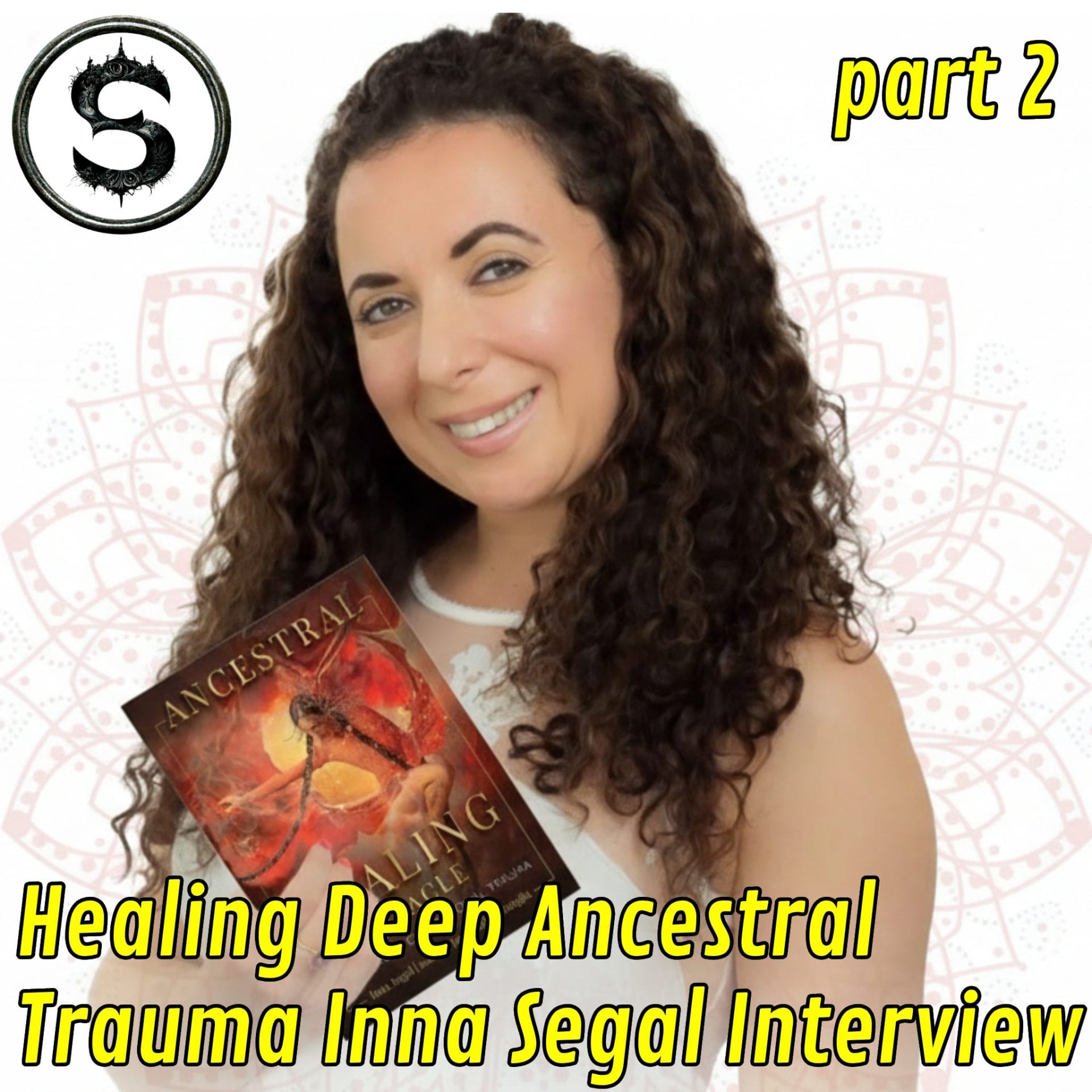
[00:00:01] Speaker A: Welcome back to Super Normalized. I'm your host CJ Barnaby and today we're sitting down with someone whose journey through healing has touched thousands across the globe. I'm talking about no other than Inner Cigar. Recently we had an interview and I realized she's only local, not far up the road and we had such a great connection that we decided to catch up for lunch and record the second half of the interview in person because we didn't get through all the questions. Because she explains things so deeply and profoundly, Ina didn't set out to become a healer. Her path began in the the depths of personal loss, losing a child, which opened a doorway into understanding the spiritual world in ways most of us would never consider. From that profound grief emerged a calling that would span over 25 years, taking her from one on one with clients to teaching transformational workshops in countless countries across the world. What makes Ina's approach so compelling is how she bridges the wisdom of Rudolf Steiner with practical, accessible healing techniques. She's not about quick fixes or instant transformations. Instead she teaches us to listen to what our bodies are actually saying to understand the connection between our physical symptoms and our emotional, ancestral and spiritual patterns. Today, Inna shares the real talk about modern healing culture, why your nervous system needs preparation before deep work, and how a single moment at her grandparents anniversary complete transformed her understanding of ancestral trauma and courage. She'll walk us through her daily protection practices and then go on to explain why that anger in your throat means something completely different than anger in your chest and reveals what she's learned about working with clients who aren't quite ready for the journey. If you've ever wondered why healing sometimes feel like it's taking forever, or if you're a practitioner struggling with boundaries of self care, stay with us. You'll get some pro tips here from Ina as she breaks down the stages of healing, the misconceptions that can actually harm your progress, and offers a refreshingly honest perspective on what it really takes to transform. Plus, she introduces her Ancestral Healing Oracle cards and shares how shifting your perspective on family trauma can turn the greatest pain into your most powerful source of courage. Whether you're just beginning to to sense that your body has wisdom to share, or you're a seasoned healer looking for deeper understanding, this conversation offers something profound.
Find out why Ina believes your body always tells the truth and how to celebrate the smallest victories and what it really means to awaken the healer within. Let's dive in.
[00:02:28] Speaker B: Welcome back to Super Normalize.
[00:02:30] Speaker C: Thank you so thank you so Much.
[00:02:33] Speaker B: It's great to have you here in person. You're my second person I've had live, which is really good. And we have a studio audience today.
Thank you.
[00:02:45] Speaker A: Now, we had a great connection.
[00:02:46] Speaker B: We were talking last time, and I only got two thirds of the way through my questions. So I'm really glad that you've come along and had a chance to sit down and we can get through the rest of the questions because there's questions.
[00:02:57] Speaker A: In here that I know other healers.
[00:02:58] Speaker B: Would love to hear too.
[00:03:00] Speaker C: Sounds great. Thank you.
[00:03:01] Speaker B: Now, this first set's about practicalities, boundaries, and self care for healers.
How do you personally protect your own nervous system while you're working with intense and ancestral grief or chronic pain clients?
[00:03:15] Speaker C: Well, I have a whole little process where I. Well, firstly, pretty much every day, there are some exceptions when something happens, but every day I have a really strong practice of protecting myself, of connecting to the divine as soon as I wake up. So the moment that I wake up, before I even open my eyes, I'm going through that process.
Then if I'm working or teaching, I'll ground myself. I'll often try and go outside first just to make sure that I'm really grounded. I also have these eurythmi exercises which come from the work of Rudolf Steiner, that teach you how to protect yourself, but also how to really come back into your body and focus workers.
And also I work with. So I have a process for protecting, but I also do it kind of like energetically as well. So I work with a particular symbol connected to it, particular colors to strengthen all the parts of the aura, and I'll even say it inside and outside and things like that. And then I also connect to higher beings that I'm again, that I've been working with for a very long period of time. And so again, I feel strengthened because it's. It's kind of in general a practice for me, but when I'm teaching in particular, it's stronger because I don't do that many healing sessions anymore. So it's. It's more just transmitting knowledge.
[00:04:57] Speaker B: Yeah, yeah, yeah, yeah. Cool.
Okay. So when you're doing that practice daily, is that. Do you like have a standard practice or does it actually challenge with your intuition? Like, I need to do this today because I've got a feeling that's coming around or anything like that?
[00:05:10] Speaker C: Definitely there's. There's a practice that I do daily no matter what, and then there's a practice that I do daily where it is constantly changing. So I.
And I encourage my students and clients to. To do that in terms of working with themes. So I'm always focus on what's my theme for the moment. So that.
Is it about relationships or is it about children? I think we were talking about that before. Or is it about my own health or. At times, yeah. I just kind of specify for myself what is it that I really want to work on. Maybe it's abundance, maybe it's expansion in the business. Maybe it's. I think in our society, especially in the generation that I grew up in, there's been a huge kind of confusion around what feminine even means, though.
So because I've been doing healing work from such a young age and teaching from when I was 22, I started teaching.
So really deep exploration of what that looks like comes back around for me constantly as a theme. Because I.
I know that if.
If my partner Matt and I have a lot of work, we end up. I end up becoming quite masculine and hardened. And I know that because of how my voice sounds when I'm speaking to him. And so I'm, you know, very conscious of that being a practice. So what do I need for my feminine to be healthy? So do I need to go out and see a show?
I mean, I want people to know that it can be fun. Do I need to go, you know, and have some space and dance? You know, do I need to talk to somebody on the phone? Right. So I feel like a practice. Sometimes people get scared and they think, oh, practice. It means it's traumatic, it's emotional, as opposed to. Well, no. What does it mean for you to be enriched and healthy?
[00:07:11] Speaker B: Yeah. Sitting in that energy and then embodying it.
[00:07:15] Speaker C: Yeah.
[00:07:17] Speaker B: Name one red flag that a client isn't ready to be traced back through their etheric timeline. And what do you do instead?
[00:07:24] Speaker C: Well, I feel like when somebody.
And this has been a big buzzword at the moment, but there's a lot of truth in it where a person's nervous system has not actually been prepared for deeper work. So again, we were talking about etheric in the way that I understand it, we're working on very deep levels that connect to vitality, ancestry, you know, stuff that you. That is very old and deep and patterns that are very deeply ingrained. And so because we live in a society where people are so disassociated with their bodies and they're in their minds all the time, so dissociated from that, from their emotions, then to me, I want to make sure that their nervous system is Capable as well as their sense of self.
So, again, I feel like a lot of people that I see in so many courses and master classes and all the things that I do have quite a weakened sense of self.
And that sense of self is actually connected to the solar plexus as well as the third eye area. And it's like they don't really deeply know who they really are and what it's about and who they. And they haven't met all the parts of them, including, as we were chatting before we started, the shadow parts, the light parts. And so if I sense that they're not strong enough, well, firstly, we work on that sense of self. And then we. I just really believe in, I guess, the part of that person, their soul, their sense of self showing me and them when they're ready for something. So I don't ever push people. I don't force anything. I just allow for things to unveil themselves gently as we go step by step.
[00:09:21] Speaker B: That answered my next question too, which was, when dealing with intense trauma events, how do you encourage and nurture change compassionately?
[00:09:27] Speaker C: Yeah. And if I can add to that, it's one of my big pet hates is people kind of going back into the. Bringing people back into traumas when they're not ready.
[00:09:38] Speaker B: Right.
[00:09:39] Speaker C: And I think unless you've been through major trauma, you actually don't realize to the degree that that can happen. And in particular, I'm gonna say with, we have so many people right now in the world that have borderline problems. Narcissistic, psychopathic, sociopathic, all sorts of aspects of mental disorders. And when somebody's been in a relationship with that person, their nervous system and their brain have actually been completely rewired, and they're rewired to a numb trauma, kind of I'm okay response. So there's all sorts of responses coming through. Most people don't actually because. Because it's been in the shadow, so to speak. Most people don't understand the depth and the levels of what narcissism actually is and does in terms of trauma.
So they often try and work with people like that. You'd work with a sexual abuse trauma or a trauma of something you've seen or divorce or whatever it is. And they don't realize how damaging that can be and how long it can take. And so I'm. I'm constantly educating myself, never stop learning. And I'm always looking at.
Again, rather than generalizing a trauma, it's like, what trauma is this? Why is this person stuck like where do we need to start in terms of bringing them to a place where they can then face this, you know?
[00:11:13] Speaker B: Yeah, that's. Yeah, that's a tough place to get to for some people because of what they've been through. And you don't recognize it. I mean, I, I've been in intense relationships with narcissists in the past. I didn't even know what they were then.
[00:11:26] Speaker C: We don't. That's the problem.
[00:11:28] Speaker B: I think I'm doing everything right. Was. It's still like a minefield though.
[00:11:31] Speaker C: Yeah.
[00:11:31] Speaker B: So it's tough until then. You can work around it. Yeah. So if there's a lot of marketplace noise for workshops, quick fixes, charismatic leaders, what's the biggest harm that you see in modern healing culture and how do you protect clients from it?
[00:11:45] Speaker C: Trying to do things too fast, pushing people, the idea of easy, fast, instant. I am against it because I spent 25 years tuning into the body and as well as all the energy bodies. And for instance, again, you mentioned the etheric.
You cannot, it doesn't work on fast, easy, instant. The astral body, which is our emotional body, can work on that, but it can also.
I used to have clients when I was doing a lot of one on one work where they would come and I would tune into them and their emotional body, which is also in charge of your immune system, your digestive system, your lymphatic system, you know, hormonal system. Right. So I would tune into them and I would go, my God, if I could describe this emotional astral body to you, it would either. There were often two ways that it would show up. Either like an ice rink and it's. It would literally be like, I'm, I could skate on this. Or it would show up like kind of torn in so many places. And usually I'd go, do you have digestive issues? And everybody would. Because, because the digestive system in itself works on digesting experiences, digesting emotions, digesting what's coming up for you. And so if you're overdoing it, if you're over pushing it, which is what I'm seeing so much of where somebody's not qualified. Like, absolutely not qualified. They've done a two day workshop and they think they can work with somebody. And it's like, no, you have someone's soul in your hands. You need years, like you actually need years of maybe different workshops and a variety of, of teachings that you then somehow bring into an alignment and an, into an understanding of what works for each person. But this quick fix Type of not really understanding much and, and then pushing and forcing. And with emotions, for instance, what I see is people wanting to get rid of the emotions as opposed to work with them or understand them. And so what I've been teaching, and I think in some ways it's both really old and really new in, in how I'm doing it, is that I no longer just work with, with any emotion directly. So what I'll do is I'll go, okay, so if I can explain why, because what everybody does is the other thing they do is generalize everything. And to me it's so obviously clear that if I'm feeling anger and I can identify, let's say, this anger, and I go, well, where in my body am I really feeling it? And if it shows up in my throat, then the anger is about the fact that I probably suppress things and I cannot say them right, because this is all about communication and, and as well as obviously hormonal issues.
But if my anger feels like it's coming from my chest, that is a completely different storyline. This could be around boundaries or the lack of boundaries that I have that could be around somebody not treating me well, not understanding me, trying to change, you know, me or, or maybe somebody who's hurt me or rejected or whatever it is, right? So the anger is coming from a very different place.
And then if we look at the liver, which, you know, everybody kind of agrees that is an area connected to anger. But that anger is also so specific to my masculine self. Meets masculine people, which could be a female as well, but who is very masculine, but who's attacking or putting me down around the fact that I might want to achieve something that he or she doesn't agree with. And so what I've been really working with is let's look at the chakra system and the fact that each chakra actually has archetypes connected to it and also timelines that, where you can look, that makes it much more understandable, especially for people who cannot tune into the body like I can, but they can still get the wisdom of the body. And so then we actually don't need memory, we don't need to go into a trauma response. What we need to do is identify the archetype and explore what is the age of this archetype? What is it holding onto?
What is the perspective that it has? Why is it holding onto it? What are the. Not just one emotion, but the different emotions that we can work with and how do we transform it in which way, in which case people can Once they connect with it, with that part, they can observe it transforming. And what we want to do is to. To go from that charged shadow feeling into really healthy feeling and way of living in the world.
[00:17:02] Speaker B: Yeah, covered so many things. I'm still thinking about.
Do you have any tips for healers who are handling instances where a client seems resistant to the healing process or does not experience any notice changes after a session?
[00:17:18] Speaker C: Well, yeah, for me, when I would have those types of clients, I would actually start with explaining to them, this is what this looks like. Things take time. Do you realize that? Do you understand that? And then I would see what they say at the end. And if they would say, so, so my fix now, am I like, is it done? Then I'd go, yep, you're not ready. I've just spent half an hour explaining. And if you're saying to me, am I done? Then obviously, like, I've just said, you need. Like, this takes months, this takes weeks.
And you're asking me if it's done, then you're not ready for this. I think you need to just get a massage or something, you know. But in general, I would, I would say to a person, depends on how they responded to things. I mean, I still occasionally do something for people that I know mainly. And recently I was doing like, yeah, a healing session with this person. And what it looked like to me originally was that he. He was quite numb and blocked.
But you don't know until you really start doing this healing work. And he was in England, I was in. In Australia.
And at one point I. I was doing some stuff and I was testing, and I was saying to him, are you feeling this or are you feeling nothing? And actually, I'm gonna say my expectations were that he was going to say, I'm not feeling much. And he was like, I am feeling it here and there and so on. And so I was like, okay, now we can, now we can go further into this. But if not, what I would say to somebody is go and work with, you know, whether it's a network type chiropractor or somebody who. An osteopath or somebody like cranial psycho therapist, someone that can help you with your nervous system because your nervous system has to be in the right place to go into the deeper layers. And also, it's okay if things don't, if they take time.
I. I also give examples of students and clients where.
I remember this guy came to see me. He. He was about 47 at the time, and he was an accountant.
So when he, when he showed up, and this is when I was in my 20s.
I remember I got him on the table and I was doing all this work energetically. And then he said to me, my God, that was amazing. And I said, really? Did you feel things? And he said, no.
I said, did you feel anything? He said, no.
I said, well, how do you. How do you know it was amazing? And he said, you really know what you.
You really look like you know what you're doing.
And honestly, it took two years for me to. And I was seeing him, I think, every maybe week to two weeks to get this protective energy off him because he was really deeply hurt by his mother and he had heart issues. That's why he came.
And by the time, by, you know, once he really opened up and we were able to work with this, his heart issues improved his relationship with his mom, improved his.
At the time, he was completely blocked to having a relationship. And then he met one of my other students, and I was like, something going on between the two of you? And they've been together for, I think it's. It's like so many years now. So it just depends. It just depends on the person. And being kind and gentle and really starting with gentle touch and breath is where I think most people may need to start.
[00:21:15] Speaker B: Yeah.
What are common misconceptions about energetic healing that you often encounter, and how do you address these misconceptions with clients?
[00:21:26] Speaker C: The biggest ones is that they don't have to participate in the process, that you're just going to do it for them, and that somehow you're just going to wave your hands and instantly they will be healed. And I meant to be honest, I'm actually a bit. Little bit shocked. But last year I was speaking to some people and they were saying. Because what I found was that when I was teaching after Covid, and this has never, ever happened before COVID After Covid, I started doing some live teaching, and I started noticing that people would leave halfway through or they just. Just go, okay, that's it. And I was like, why are they doing this? This doesn't make sense. It's never happened before. I've never experienced any this. And it was. I would go from one city to another, and this was happening. And I started asking questions, and people were saying, well, because I came with the thought that you were going to heal me instantly. And now you're actually explaining that I'm going to have to do all this work. And that's not what I signed up for. And I was like, where was the part that you, where did you read about what the workshop was?
You know, and they were like, in the last half a day, you're not going to heal me. So what's the point of me being here? And it was just, it really shocked me because it was like, well, hold on a sec. Where did we lose that part? And why do we all of a sudden think that? It's just magical and this sense of it, it's just, and you're gonna do it, and you're the one who knows and you're the one who can see. I just don't know anything. I'm just gonna sit here and I will, I will walk out and I'm gonna be healed. And sometimes we would get really, like, aggressive emails saying, well, you didn't heal me, I paid you. And it's like, I think you missed a bit, that you have to do the work and you don't want to.
[00:23:18] Speaker B: That's you.
[00:23:19] Speaker C: That was, that's been it, Emily.
[00:23:22] Speaker B: And that started happening more after Covid.
[00:23:25] Speaker C: I, I, I just, I don't know if people somehow went into that state of more of a childlike rather than an adult, like, state of I'm in fear. And so many people obviously have become ill from all sorts of poisonous things we know about. And I just feel like they have.
Well, I mean, there's so much to unpack around that I'm just opening up a really intense door here. But I think that a lot of people have been affected energetically. I think a lot of people have gone into that child state, like I said, where I'm in so much fear. A lot of people have maybe lost aspects of their own soul. And now we were talking during, when we were having lunch about entities and stuff, and they're having these beings that are part of them. There's just so many reasons.
[00:24:23] Speaker B: Yeah. To me it seems like a bit like ptsd.
[00:24:26] Speaker C: There's that part of it as well. Yeah.
[00:24:30] Speaker B: So looking back over the many years of your work, which outcome feels most meaningful to you beyond symptom reduction?
[00:24:37] Speaker C: I feel like, for me, when people understand who they are on a deeper spiritual level and why they're here, and they have been extremely fortunate in my life to come across the Wagabrud of Sina and have teachers who, you know, studied that work for 40 years, by the time that I come across them and have just been there to give me an opportunity to go into areas of understanding who we are, where we come from, how we evolved to be where we are, and where we're evolving to in such detailed, soul enriching ways that I feel like enriching my soul and understanding things that are so intricate, I'm gonna say where it's like there's one thread that connects to another to another, but also stretches you to levels that you never thought you could stretch your mind to. Like that's what I'm super passionate about.
[00:25:49] Speaker B: I can hear that in your words.
It sounds more like you're taking it from the point of.
About healing, but then healing your understanding of what your soul really is.
[00:25:59] Speaker C: Yeah. And about, I guess, where.
Because the journey from the beginning took me. I mean, I ended up doing healing work partly because I lost a child. And unless you have that experience and I don't wish it on anyone, to be honest, you don't understand that depth of need and desire to understand what happens in the spiritual world and why does it happen and how does it happen and what is the journey, I guess, of reincarnation and understanding the higher beings and the angelic realms and the archangelic and the archai and exousia and so on. Like that's been so deeply enriching for me as well.
[00:26:44] Speaker B: Yeah.
Brought some cards today.
[00:26:47] Speaker C: Yeah.
[00:26:48] Speaker B: If you'd like to tell us all about that.
[00:26:49] Speaker C: Well, one of the aspects. Ancestral healing oracle, one of the aspects, and in major, major aspects of healing is looking at your ancestry starting from the womb to the stages of development.
So essentially from when you're in the womb, you have the three trimesters and there's a lot that happens there that we absorb and then zero to seven, we absorb. We. We don't have boundaries. There's no capacity for boundaries because we're actually in the etheric body of the mother or whoever's looking after us the most could be the father.
And. But as we kind of evolve or grow, we start to. From 7 to 14, our own etheric body starts developing and we start to potentially either take on. Around the age of nine, we're taking on whatever we've seen from our family or we're rejecting it, or we're taking on some and rejecting others aspect.
And people just don't understand most of this and how this really works. And then I also found in. Even in my own. We were talking about my children in my own family, where my daughter. Because I was very young when I had my children, my daughter said to me, mum, you know, I just kind of. I forgive you any mistakes because we grew up together.
Because I was in my early 20s when I had a.
She's Like, I just feel like we grew up together. And she would say to me, in this life, it's your first time being a parent. So, like, I just really admire you and whatever, you know, understand. Whereas my son went the other way, and he kind of went, you did this, and you went there, and you and this. And I feel like the more we. I. I can't make somebody in my family do this work, right? But as I embrace it and align all of this inside of me and actually, you know, honestly have a conversation, then what opens up is that all the stuff that was in the shadow, that has been put into the shadow starts to awaken and transform into the light. And so, as you know, today when we were having lunch, I was saying to my. My son's messaging me, and it's. It's like this is his moment, and he's talking about healing and ancestral healing. And that even though when he was at his worst, his dad and I were still gentle, still kind, well, I wasn't always gentle, but loving to him sometimes. It was very clear boundaries. But now he can really take that richness and allow it to help him grow instead of the opposite, right? Instead of suppressing him. And that's really what ancestral work's about.
Looking at things and going, okay, my mom couldn't give me this, or my dad couldn't give me this, or my great grandparents couldn't express themselves. And so I have some of this inside of me, but as I recognize it, I can reclaim and I can change my perspective.
And so now I can grow instead of the opposite of it. And I know if I can share this, I had this incredible experience when I was 22 where my grandparents had their 50th wedding anniversary. And I remember going up the stairs of this restaurant, and all of a sudden, something happened where I just couldn't see people. I could only see the soul. And I had never had this experience before. And up until that time, I always saw my grandparents as people who'd gone through hell, like through the war. My grandmother literally had her mother, like her mother was shot in front of her to save my grandmother's life. She was one of eight children.
All her brothers and sisters were shot or killed in some way. And so my grandmother had so much trauma inside of her. And then my grandfather ended up in Siberia in a camp for 10 years, from 14 to 24, for something he didn't do, just being in the wrong place at the wrong time. And he was. He weighed 24 kilos at the time that he left at 24. Nobody in his family knew he was. If he was alive or not.
And he said to me, you don't know how many times I had a gun at my head or like, it was horrific.
And to me, all the stories I heard, it was like my grandparents were victims. Like, they. I don't understand. I don't understand what people had to suffer at that age. You know, that's what I was thinking to that degree.
And on that day, for the first time in my life, I remember as I was. I was dancing with my grandmother, and then, you know, I was dancing with my grandfather, and it was like, oh, my God, I've been seeing this the completely wrong way. They're actually the most courageous people I've ever met. And how are they still so loving and kind and pure and caring?
And everything in my mind of how I had seen them prior to that had changed. And all of a sudden I went, actually, they are my example of courage, of how to live with courage and how to let go of the most traumatic, horrific ways that other human beings treat you. How were they able to. And so I started asking questions and finding out. And so that part of my ancestry where I would constantly feel it at the pit of my stomach, you know, this heaviness, this ball of energy that was dark and dense, it started to dissipate, and it was like, oh, my God, actually. And. And so in my life, whenever I. And I've traveled a lot and I've taught in countless countries around the world, whenever I'd go to a new country and it would be a country I didn't know or. And some fear would show up, I would have this conversation with myself based on this ancestral transformation where I would go, so you're scared? Yeah. Okay. Why are you scared? Because it's new. It's different.
You don't know the culture. You don't know the people.
But what did your grandparents go through compared to you going to a new country, not knowing the language and getting lost, maybe on some street?
That's not that scary, actually, compared to having a gun at your head.
So this is nothing. Just go. And. And people in the different countries would even say to me, wow, you're so courageous. And I'm like, this is not courageous. This is.
There's nothing courageous about this compared to the experience that my grandparents went through. And it. It was.
It became so much easier as soon as I started thinking that way, you know? And that's. Yeah, that's.
[00:33:53] Speaker B: Is that part of the spawning for this?
[00:33:56] Speaker C: Yeah. Yeah, yeah, it's, it's getting people to both see what am I dragging along that's not even mine, that I don't need to work with, that I can just transform. And I'm just doing it because it's part of my family and I'm not even recognizing it and how do I be me?
And then there's the part of it of going, well, maybe I'm judging my family, maybe I am seeing only the negative. And there's so much positive that I could embrace that could really, really help me move forward. That's what this was really about.
[00:34:31] Speaker B: It's like turning around your whole standing in a new direction.
[00:34:34] Speaker C: Yeah.
[00:34:35] Speaker B: Wow, that's a powerful. And for us too. Now, what are you most excited to teach next and how can the audience join in with you?
[00:34:44] Speaker C: Well, actually speaking of this, I. The two things that. Well, I mean there's so many things that excite me. I only teach things that excite me, to be honest. But I'm teaching, I teach this 10 day course called Awaken the Healer within and I'm always excited to teach it. I'm never not excited, even though I've done it so many times because there is, each group has a theme and there's so much understanding of who I am. What's my sense of self, what does it mean to work with all these subtle bodies, how do I work with the archetypes, how do I work with my chakras, how do I work with my thera cans? It's like the door that changes everything for a lot of people. So I love that. But I'm also actually haven't taught ancestral healing for a while and my intention is to look into doing this at the end of the year. And that is also really exciting because I combined that particular course with again with archetypes and looking at the feminine and the masculine and the shadow and the light of the particular archetypes that I feel are deeply connected to our ancestry. And so I'm excited to do it again because it's been a while since, since I've done it. And the easiest way for people to connect with me is to go to my website, innocent.com and as I always say, in the last few years I've been really excited to, to give people an option to take a step forward without excuses.
And so I've created several master classes on all sorts of different topics from the basics of understanding the secret language of your body to awakening the healer within. And again, looking at these archetypes and chakras and also, I think I might have mentioned it last time you interviewed me. I'm in this process still of writing a book about the different stages of healing and so understanding the stages.
So people have that in one kind of one place under
[email protected].
[00:37:06] Speaker B: Okay, well, I'll point that out to people in the show notes down below. Do you have any parting invitation to someone who's lost faith that their body can tell the truth?
[00:37:17] Speaker C: I can't see how your body doesn't tell the truth.
I feel like most people would probably be.
Be open to the idea that their body is saying something.
I think that lots of people may have resistance, are not sure about how to heal that. And what I want to say is that you've got to find somebody to guide you when you're at the beginning and somebody that you.
There's so many people out there and you need to discern. You absolutely have to discern who you go to, someone that you feel aligned to and someone who speaks your language and someone who has this sense of.
I feel when you're new to it, when you're scared, you often need somebody very calm and gentle. So actually finding a healer or practitioner that can hold space for you and encourage you and.
And has the capacity to see the smallest changes. And my biggest thing with people who heal, as opposed to those who don't, is the ones who don't heal are always looking for what's wrong or what's not working or what's numb. And those who heal the fastest are always acknowledging and celebrating the smallest things. The smallest changes, right. They go, I feel better for a minute. Okay. Even a minute in the day is worth celebrating. So let me just take a moment and acknowledge and celebrate that my body could work with me. And I also think that it's a combined effort. So when. If you're not ready for healing, healing in terms of that type of internal work, then you might start with changing your diet, detoxing, cleansing.
A lot of people are, because it's more physical and much more open to that first, you know, taking particular herbal supplements that still support and allow you to have some kind of transformation on the physical level, but maybe not, you know, on the emotional yet. And then there's likely to be a breakthrough and. And also I'm a big fan, like I said, I mean, when I kind of made a joke. But doing body work. So even something like acupuncture, just creating these openings or pressure point work that allows you to have some more access to yourself and your.
Your inner self.
So never give up.
[00:40:04] Speaker B: Never give up. That's the truth.
Thank you so much for coming on the show. Thanks for coming and talking in person. I really appreciate that. It's been a pleasure to meet you in person and I'm appreciating everything you shared here again today. And I thought that was getting short. That was good.
[00:40:20] Speaker C: I'm not good at short.
[00:40:22] Speaker B: Just say goodbye to listeners.
Wow.
[00:40:30] Speaker A: I gotta say, that was such a spectacular conversation with Inna. She packs in so much information in her answers that I gotta say, I have a bit of trouble wrapping my head around it at first, but since recording it, I've actually listened again, and there's just so much more in it that I didn't catch even while I was sitting there listening.
So if you've enjoyed today's show, I'm sure that you will make sure that you reach out to inner and say thanks directly. I'm really happy she actually gave me a set of these cards so I can work on my ancestral trauma as well. I mean, it says transform generational trauma, which ties right in with the course that I'm doing right now on Shadow Work with Gordon White of Rune Soup.
[00:41:12] Speaker B: It's fantastic.
[00:41:13] Speaker A: So I'm very, very grateful in it. Thank you so much. Now, if you've enjoyed today's show and you're on a podcast app, give me five stars and say something really nice. And if you have any questions around any of this, please write them down in the comments below and I'll see what I can get done about getting those answered. And if you wanted to as well, please tell me where you are in the world. I'd be very interested to know because I have a lot of watches, but not many commenters. I'd love to hear your comments. All right, then, thank you very much for listening. And if you've enjoyed this episode, you'll enjoy her last one as well right there.